
Checking for a Warrant in Tarrant County
Let the citation, court notice, or cause number pick your first call. Tarrant County runs no single public search covering every criminal, JP, and municipal warrant. The Sheriff's Criminal Warrants Division states plainly that it does not release criminal-warrant information to the general public, so a licensed bondsman or attorney must use the qualified confirmation route the Sheriff names. For a ticket, the municipal or JP court that issued it is the right office. Keep the full name, date of birth, citation or case number, and the court shown on the paper close at hand. A public case result is only a lead. Confirm it with the court before acting. If the matter involves a criminal arrest warrant, talk with a Texas attorney before making plans to appear. One blank search never proves that no warrant exists in the county's system.
- Read the notice for the issuing court and type of case. Start there, not with a city or county name alone.
- For a city citation, use that municipal court's own case or warrant page. For a county, DPS, or Sheriff's ticket, use the JP precinct printed on it.
- For a felony status question, follow the Sheriff's qualified route through an attorney or licensed bondsman. The public Sheriff page is not a name-search tool.
- If you need a document, use the District Clerk search for executed warrants or the county's public-information request route for releasable records.
- Ask the issuing clerk what payment, appearance, bond, or recall process applies. Keep the receipt and confirm the court's update.
Tarrant County Warrant Search Channels
The public systems answer different questions. Odyssey Public Access searches case records and calendars after a user chooses a location and case type. It is not a full warrant index. The District Clerk search is for executed probable-cause and search-warrant documents. Municipal citation portals cover only their city's court. The Sheriff page explains its restricted criminal-warrant policy and points traffic readers to the issuing agency.
A full check may require more than one office. No statewide Texas web portal was found that lets the public search every warrant. Use the Sheriff's Criminal Warrants page to choose the permitted route for a criminal matter.
Open the Sheriff's Criminal Warrants page for the access rule and division contact context.
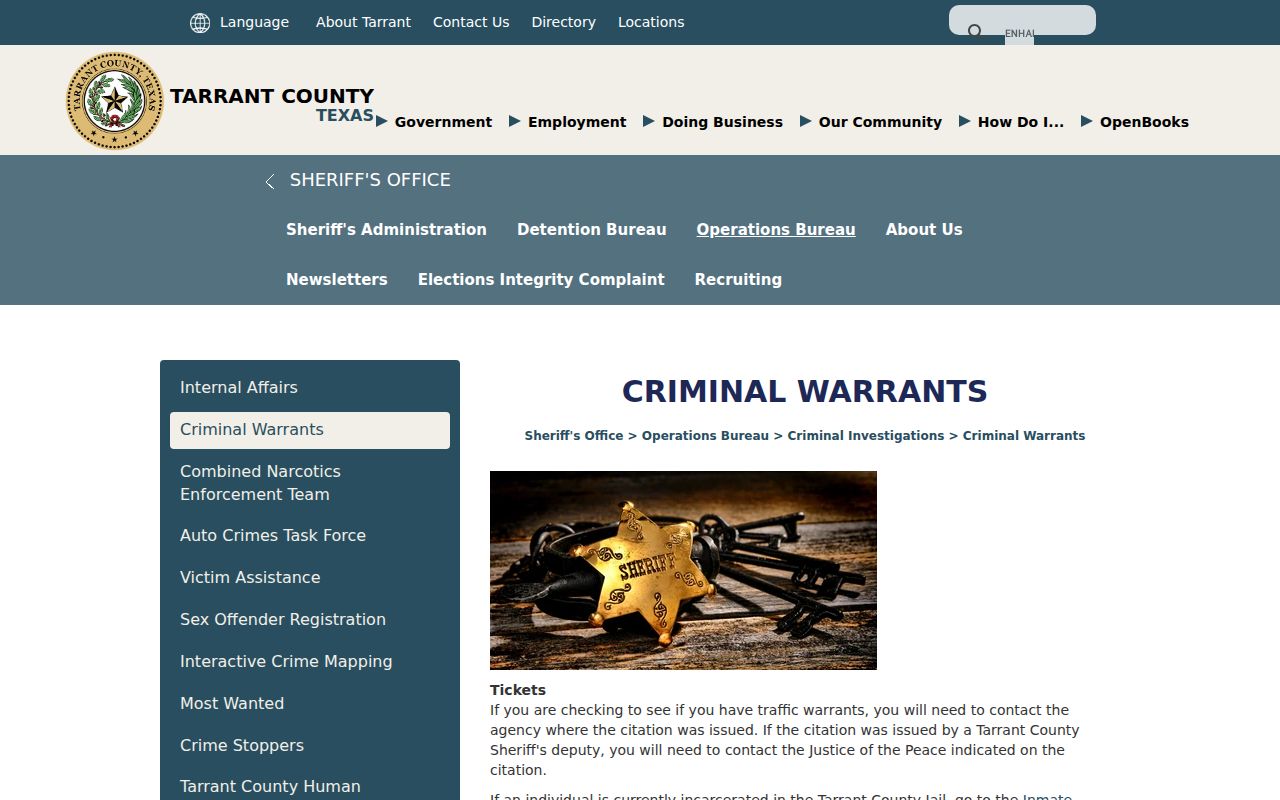
That policy differs from a public case search and should shape the first call.
Tarrant County Warrant Types
Warrant labels point to different courts and different events in Tarrant County. A missed ticket date may bring a lower-court warrant, while a capias pro fine follows a judgment whose terms went unmet. A felony arrest warrant comes only after a probable-cause review. A search warrant, by contrast, authorizes officers to search a place or property. Ask which court issued the paper before choosing a payment or record channel.
| Warrant Type | How It Arises | Who Issues It |
|---|---|---|
| Arrest warrant | Probable-cause process in a criminal case | Magistrate or judge |
| Bench or FTA | Missed appearance or court order | Court holding the case |
| Search warrant | Probable cause to search a place or property | Magistrate or judge |
| Capias pro fine | Failure to comply with a fine judgment | JP or municipal court |
Tarrant County Executed-Warrant Files
A search-warrant document is not a list of unserved arrest warrants. Tarrant County's District Clerk lets the public search executed probable-cause and search-warrant records by warrant number or by person and location information. A record may hold an affidavit, execution details, and return information. Ask the clerk about certified copies. That search does not promise a live status check for every criminal warrant, though the District Clerk's page describes the document search and its copy route, and the clerk's instructions walk through it.
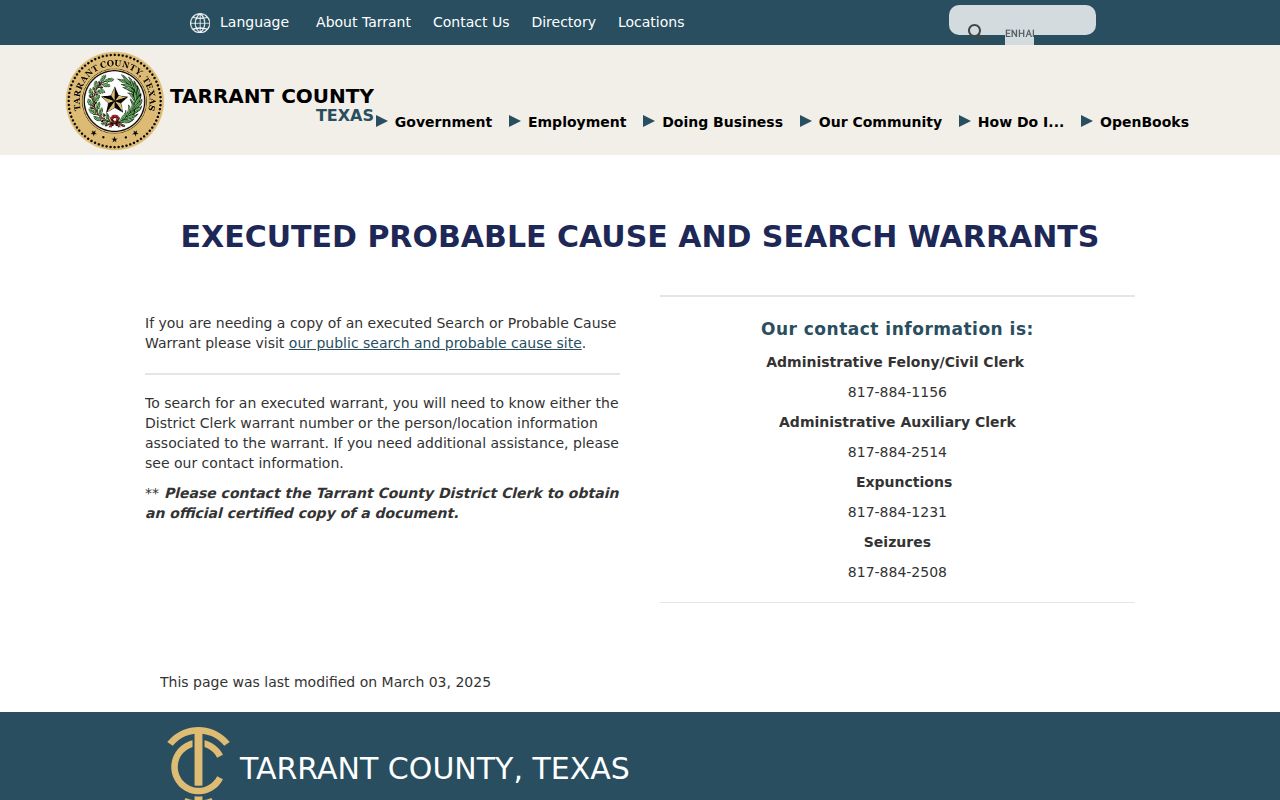
Use Odyssey or the issuing court for case settings and other court records.
Inside a Tarrant County Warrant Record
What a Tarrant County warrant record shows depends on the system holding it. A court or agency may list a case number, issuing court, offense, date, bond type, status, and a service or return entry. A case docket often shows hearings rather than law-enforcement status. An executed-warrant file is a document record instead. No single common record layout covers every court in the county.
| Number | Use the number on your notice; no countywide public sample format was found. |
|---|---|
| Case type | May identify a felony, misdemeanor, JP citation, city ticket, family matter, or search document. |
| Issuing court | Names the court that controls settings, payment, and recall. |
| Bond or amount | May be case-specific. A bond is not the same as a fine or processing fee. |
| Status | Portal terms vary; confirm active, paid, recalled, or served status with the issuer. |
Tarrant County's Eight JP Warrant Routes
Tarrant County's eight Justice of the Peace precincts handle Class C matters, including county, DPS, and Sheriff's citations, and the court printed on the ticket is the best locator. JP1 says a missed appearance can lead to an arrest warrant. JP2 warns that a ticket left unpaid or without bond may bring a warrant too, and that an after-hours payment will not recall an active warrant until the next business day. The county directory gathers all eight precinct contacts and traffic links in one place.
Open the JP court directoryUse the precinct on the citation rather than guessing from a home address.
Issuing and Serving Warrants in Tarrant County
Courts and magistrates in Tarrant County issue process; peace officers serve it. District Courts handle felonies, County Criminal Courts hold county misdemeanor cases, and JP and municipal courts issue fine-only and city process. The County Clerk and District Clerk keep separate case records. Sheriff's deputies, constables, city police, and marshals may all serve warrants depending on the case and jurisdiction. The Sheriff also describes fugitive, mental-warrant, extradition, transport, and clerical functions, and says law-enforcement staff receive 24-hour confirmations. That service is not a public status line.
Tarrant County Sheriff's Criminal Warrants Division
200 Taylor Street, 6th Floor
Fort Worth, TX 76196
817-884-1289
Tarrant County Public-Records Requests
A public-records request can seek a releasable record, but it cannot force the Tarrant County Sheriff to give the general public a criminal-warrant confirmation. The Sheriff's Records Division accepts online requests, email at TCSO_Records@tarrantcountytx.gov, and mail or in-person requests at 200 Taylor Street, sixth floor. Include the record type, date, report number if known, place, and enough detail to locate the file. The county PIA page links JustFOIA and also accepts mail, fax, email, or in-person requests, and its steps spell out each channel.
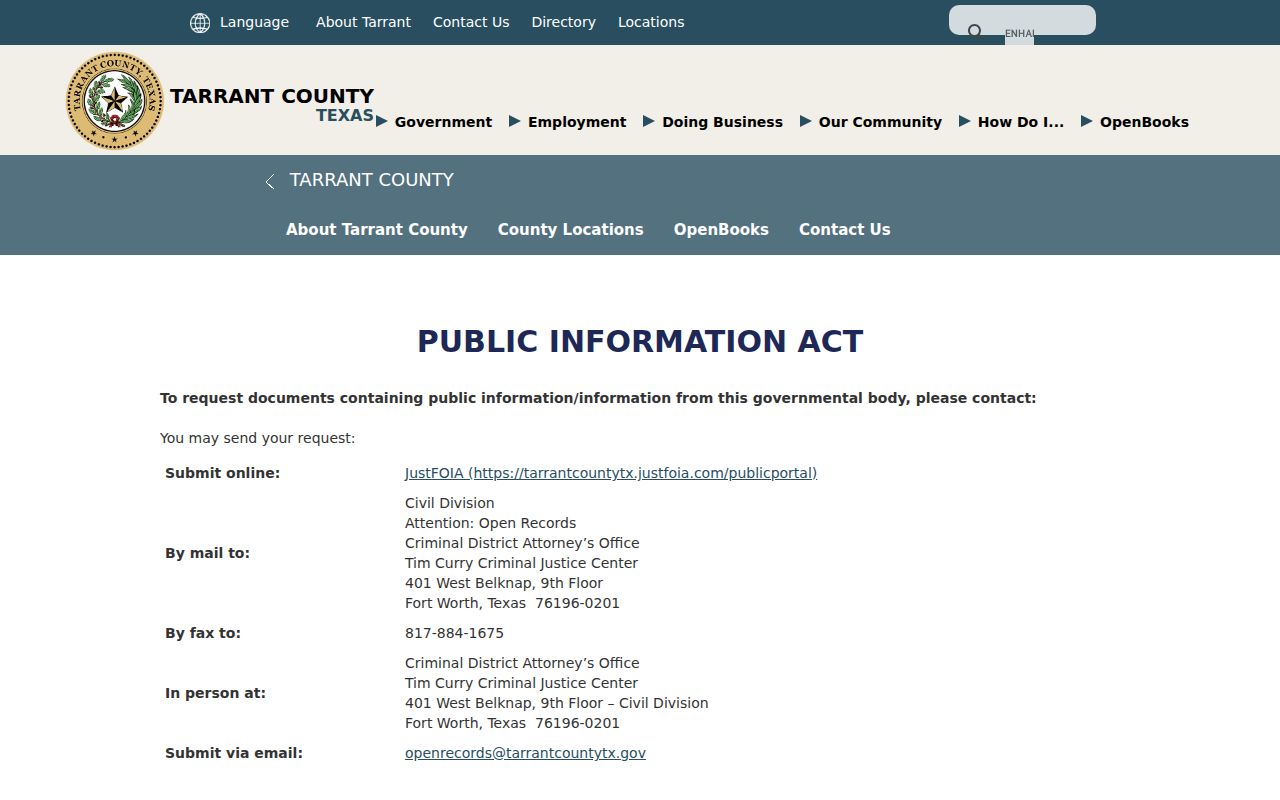
Costs can apply in Tarrant County. If charges may exceed $40, the county sends an itemized estimate before any work begins, and some records can still be withheld.
Tarrant County Warrant Bond Desk
Posting bond is a release condition the court sets, not a payment that ends a case. The Tarrant County Jail Bond Desk sits at 100 North Lamar. It posts bonds around the clock. Call ahead to learn whether a bond is set and for how much. Tarrant County publishes no countywide bond schedule and no general motion-to-recall fee. The official bond page gives the desk's location and the phone route for an existing booking or set bond.
Check Tarrant County bond instructionsTarrant County's Sheriff's homepage also links bond, records, warrant, and Most Wanted resources.

That section only routes visitors. It is not a warrant-status search for Tarrant County. Before traveling, ask an attorney or licensed bondsman how the issuing court handles an unserved criminal warrant.
If You Have a Warrant in Tarrant County
First, name the court and the warrant type. Then ask the clerk what options apply. Appearance, payment, bond, or a motion may all be on the table. For a criminal matter, Tarrant County's Sheriff does not confirm warrants to the general public, so an attorney or licensed bondsman is the permitted route. A lawyer can ask the issuing court about a voluntary appearance, bond, or a motion to recall or quash. A recall stops the warrant process. It does not settle the charge or the fine. City rules vary across Tarrant County. Fort Worth and Arlington describe Safe Harbor for eligible city matters, while Mansfield lists payment plans and credit-time-served paperwork for some cases. Keep proof of every payment, and ask when the court updates its status.
Important: Before a voluntary appearance, ask counsel and the issuing court what applies; city Safe Harbor terms do not cover every Tarrant County warrant.
OmniBase and Tarrant County Traffic Warrants
Texas DPS runs a Failure to Appear/Failure to Pay Program that can place a hold on driver's-license renewal when a court reports an unpaid citation or judgment. It is not a public warrant search. DPS tells drivers to contact the reporting court about the fine, a trial, or a payment plan. The FAQ says processing a release can take up to seven business days. The hold does not prove the exact status of an arrest or bench warrant in Tarrant County. For warrant status, use the court on the citation. Then take the license question to DPS. For that, DPS explains its FTA/FTP program.
Tarrant County Warrant Records and Public Access
The Texas Public Information Act, Government Code Chapter 552, covers public-government records, subject to exceptions. It does not open every warrant record. Juvenile warrant details may stay confidential under Family Code Chapter 58. A search warrant affidavit usually becomes public after execution, under Code of Criminal Procedure Chapter 18, with exceptions. Exceptions cut both ways. Tarrant County's issuing-court records desks explain what is releasable.
Key Rules:
Texas Government Code Chapter 552 sets the public-information process and its exceptions.
Texas Code of Criminal Procedure Chapter 18 governs search warrants and public access to executed-warrant affidavits, subject to law.
Texas Family Code Chapter 58 establishes confidentiality rules for juvenile files and related arrest information.
Tarrant County City Warrant Lists
City portals cover only their own court matters. Arlington's Open Data table lists Arlington Class C cases. It is capped at 2,000 records. Grand Prairie refreshes its citation and warrant search daily except weekends. Mansfield posts an alphabetical active-warrant list. A missing entry can mean another court, a sealed file, or a delayed update. Follow each city court's own instructions rather than treating one portal as the Tarrant County list. The Sheriff's Most Wanted program is a curated public-safety list, not a roster of all active criminal warrants, and its official page warns readers not to approach anyone listed.
Open the official Most Wanted program pageIt cannot confirm a personal Tarrant County warrant status.
Tarrant County Warrants by City
Tickets and municipal warrants stay with the issuing city court. In Tarrant County, the five largest city systems by 2020 Census count run distinct lookup and resolution routes. The figures are a census vintage only. They are not current population estimates, so pick the city where the ticket or notice began and use its police and court details.
Fort Worth Warrant Search
918,915 in 2020 · Municipal Court, walk-in and virtual options
Arlington Warrant Search
394,266 in 2020 · Class C Open Data and Warrant Unit
Grand Prairie Warrant Search
196,100 in 2020 · daily except weekends citation lookup
Mansfield Warrant Search
72,602 in 2020 · Alias Warrant and capias pro fine terms
North Richland Hills Warrant Search
69,917 in 2020 · multi-field portal and payment timing